The Dual Nature of Reality: Waves, Particles, and Quantum States
- Subject
- Physics
- Published
- Tags
- Quantum Computing, Physics, Cosmos
- Exposure0:00
Human intuition is strictly macroscopic. We evolved in a world governed by classical mechanics. In this world, a rock is a solid, localized object. A ripple in a pond is a continuous, spreading disturbance. These two concepts are mutually exclusive. A rock cannot interfere with itself like a wave, and a water ripple cannot strike a window like a localized rock. Yet, when physicists began peeling back the layers of reality at the atomic scale, this neat separation collapsed. The universe at its fundamental level refuses to choose between these two categories. Matter exhibits characteristics of both discrete particles and continuous waves depending entirely on how we observe it.
The Double Slit Experiment
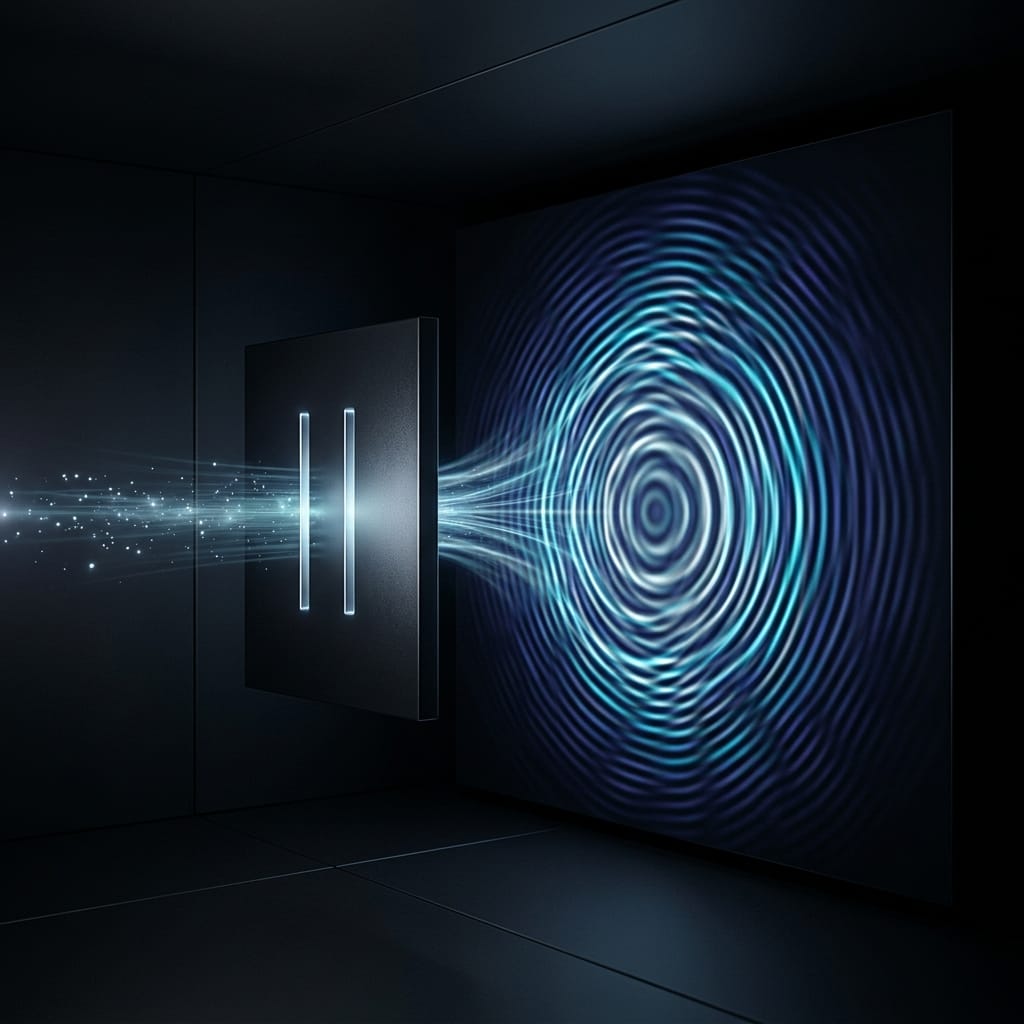
The definitive demonstration of this paradox is the double slit experiment. Imagine firing bullets at a steel plate with two vertical slits. The bullets that pass through will hit a wall behind the plate, forming two distinct vertical bands directly behind the slits. Now, imagine sending water waves through those same slits. The waves pass through both openings, spread out, and interfere with one another. When the peaks of the waves meet, they amplify. When a peak meets a trough, they cancel each other out. This creates an interference pattern of multiple alternating bands of high and low intensity.
When physicists fire a beam of electrons at a similar double slit, they expect the electrons to act like bullets and form two distinct bands. Instead, the detector records a complex interference pattern. The electrons are behaving exactly like waves. The profound mystery deepens when the experiment is modified to fire electrons one at a time. A single electron is fired. It hits the detector as a discrete, localized point. Another is fired, landing as a single point. But over time, as thousands of individual electrons are fired one by one, the accumulation of these single points builds up the exact same interference pattern. A single electron must be passing through both slits simultaneously, interfering with itself, before collapsing into a single point on the detector.
Quantum States and the Wave Function
This behavior cannot be described by classical physics. It requires a completely new mathematical framework centered on the concept of a quantum state. A quantum state does not describe a particle with a definitive location and velocity. Instead, it describes a probability distribution. In the mathematical formulation developed by Erwin Schrodinger, this is known as the wave function.
The wave function is a mathematical object that encodes the likelihood of finding the particle in any given location. The electron passing through the double slit is not a physical wave of matter in the way water is a wave. It is a wave of probability. Before it strikes the detector, the electron exists in a superposition. This means it exists in all possible states and locations described by the wave function simultaneously. The electron has no concrete, discrete reality in space until it is forced to interact with a macroscopic system like the detector screen.
Heisenberg and the Limits of Knowledge
To understand why this is a feature rather than a bug of the universe, we must look at Werner Heisenberg and his Uncertainty Principle. Heisenberg mathematically proved that it is physically impossible to simultaneously know both the exact position and the exact momentum of a particle. The more precisely you measure where a particle is, the less precisely you can know how fast it is moving, and vice versa.
This is not because our microscopes are flawed. It is because the particle itself does not possess definitive values for both properties at the same time. If a particle has a perfectly defined position, its wave function is compressed into a single spike, meaning its momentum wave is infinitely spread out. If it has a perfectly defined momentum, its wave function is a uniform ripple spread across all of space, meaning its position is completely undefined. The inherent fuzziness of reality is structurally built into the mathematics of the cosmos.
The Collapse and the Observer
The act of measurement is a destructive and definitive event in quantum mechanics. When the probability wave of the electron interacts with the detector, the wave function collapses. The infinite possibilities instantly reduce to a single, localized reality. The particle has chosen a position. If physicists place a detector right at the slits to see exactly which slit the individual electron passes through, the interference pattern completely vanishes. The act of measuring the path forces the electron to act strictly as a particle. It stops behaving as a wave. The universe seems to know it is being watched.
This collapse mechanism remains one of the most heavily debated topics in physics. Does human consciousness trigger the collapse? Does the universe split into multiple realities for every possible outcome? Or is the collapse simply a thermodynamic interaction with a larger system? The physics community has yet to reach a definitive consensus.
The Probabilistic Foundation of Reality
Regardless of the interpretation, the core truth remains. The universe is not deterministic. If you know the exact initial conditions of a quantum system, you cannot perfectly predict its final state. You can only predict the probability of various outcomes. Wave particle duality is not a failure of our measurement tools. It is a fundamental characteristic of nature. The bedrock of our physical reality is woven from uncertainty, probabilities, and shifting states.
As mentioned in my post on Order in the Chaos, Albert Einstein famously could not accept that the entire universe operates purely on chance rather than absolute certainty. He summarized this philosophical rejection in his famous 1926 letter to Max Born, stating that "God does not play dice with the universe." Yet, nearly a century of experimental physics has proven him wrong. The quantum world is inherently unpredictable, and chance is the ultimate architect of reality.